
The overlooked part of the customer experience
In mid-range apartment blocks, hotels, aparthotels and student accommodation, shared circulation areas form part of the customer experience. A resident or guest does not only form a lasting opinion from the flat, room or reception area. They also build that opinion through the routes they use every day, including corridors, lifts, stairs, landings and entrances.
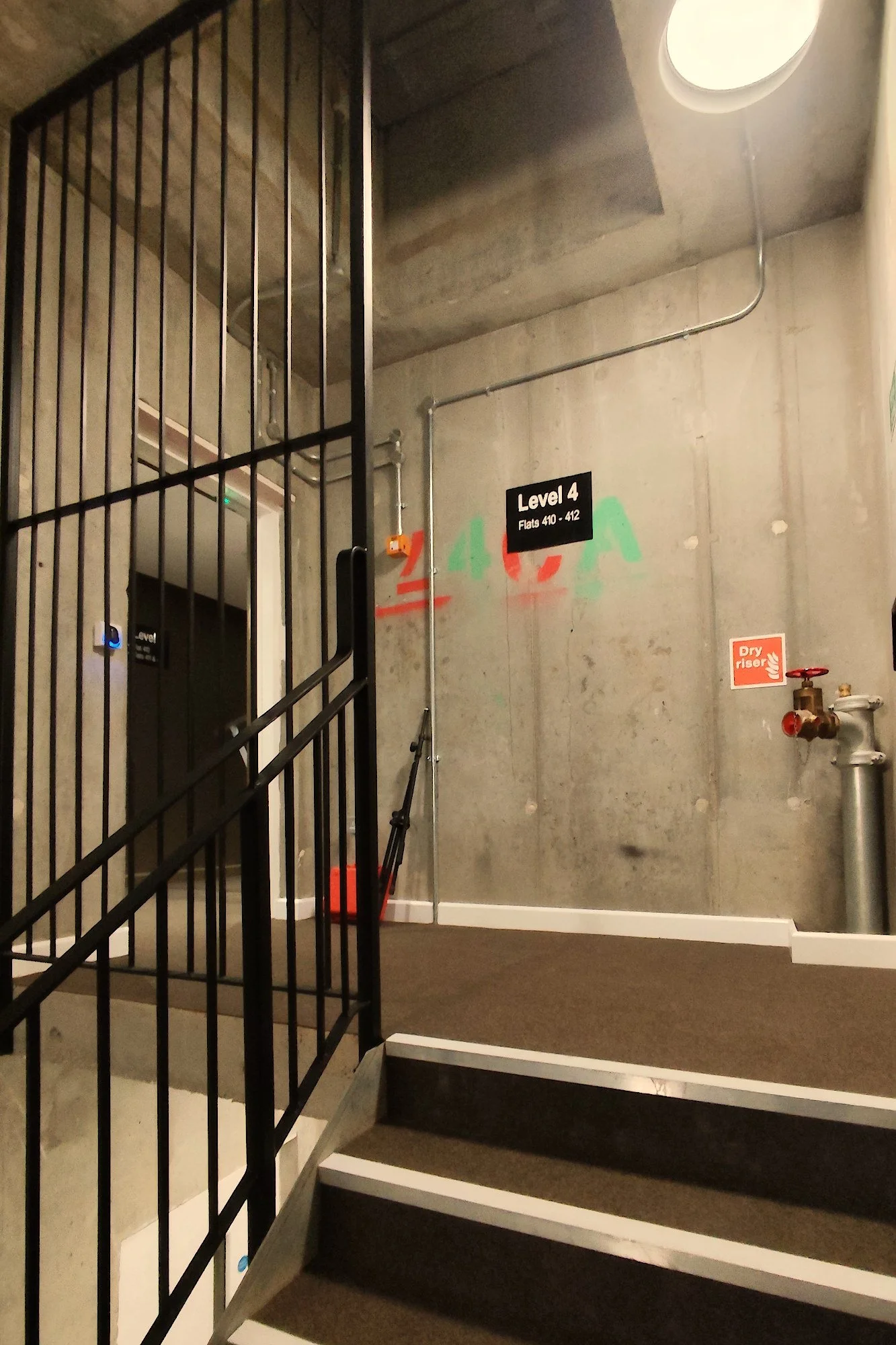
Exposed concrete stair core with minimal absorption. Durable on paper, but acoustically harsh in use.
The stairwell is often where that experience weakens. In many schemes, stair cores are treated as secondary spaces, designed mainly for durability, fire safety and cost control. Exposed concrete, visible services and minimal finishes can look practical and efficient on drawings, but in use they often produce a hard, echoing space that feels more institutional than residential.
Why this matters in mid-market schemes
This issue matters most where quality perception has commercial value. A budget block may not lose much by having a harsh stairwell, because the market expectation is already low. A private house has no shared internal circulation area in the same sense. But for mid-market apartments, hotels and other residential-style accommodation, common areas help set the tone for the whole building.
A stairwell with exposed concrete walls, hard landings and little absorption creates a familiar sound. Footsteps become sharper, doors sound more abrupt, and voices carry further than expected. Conversation also becomes difficult to follow due to the echo.
Not a grand hallway, just a harsh stair core
This is not the same as a large hotel lobby or entrance hall, where sound and volume can sometimes add a sense of scale. A stairwell is a close-range circulation space. People are near the walls, handrails, doors and each other. Echo in that setting rarely feels impressive. It usually feels harsh, awkward and uncomfortable.
The result can be a space that looks durable but feels cheap. Exposed concrete is not automatically poor design, and it can be part of a deliberate architectural language. But when every surface is hard and there is no meaningful control of reverberation, the outcome is often not “minimalist”. It is simply under-finished.
Stairwells do not have to be treated as leftover space. In some schemes, internal circulation is deliberately designed as part of the resident experience. A RIBA Regional Jury, commenting on Wilmott Court, described the internal circulation spaces, and particularly the circular stairwell, as “well-resolved and inspiring”. That is the opposite end of the spectrum from a hard, echoing concrete stair core with minimal finishes.
When people actually use the stairs
For hotels, aparthotels and higher-quality student accommodation, this can be particularly noticeable. Guests may use the stairs when lifts are busy, when they are only moving one or two floors, or when they prefer not to wait. Staff also use these spaces throughout the day. If the stairwell feels like a service core rather than part of the guest environment, it can undermine the wider impression of the building.
For apartment schemes, the issue is similar. Residents may use the stairs for exercise, convenience, moving items, avoiding lift delays or during lift maintenance. Even if the lift is the main access route, the stair is still part of the lived experience of the building. When the lift is unavailable, the stair effectively becomes the main route through the building.
Circulation spaces are not just routes through a building. They also shape how residents and neighbours interact over time.
“Evidence shows that the thoughtful design and placement of common spaces — such as amenities, circulation areas, and outdoor spaces — can greatly enhance connections among neighbours.”
— Housing LIN, Designing Multi-Unit Housing for Social Wellbeing
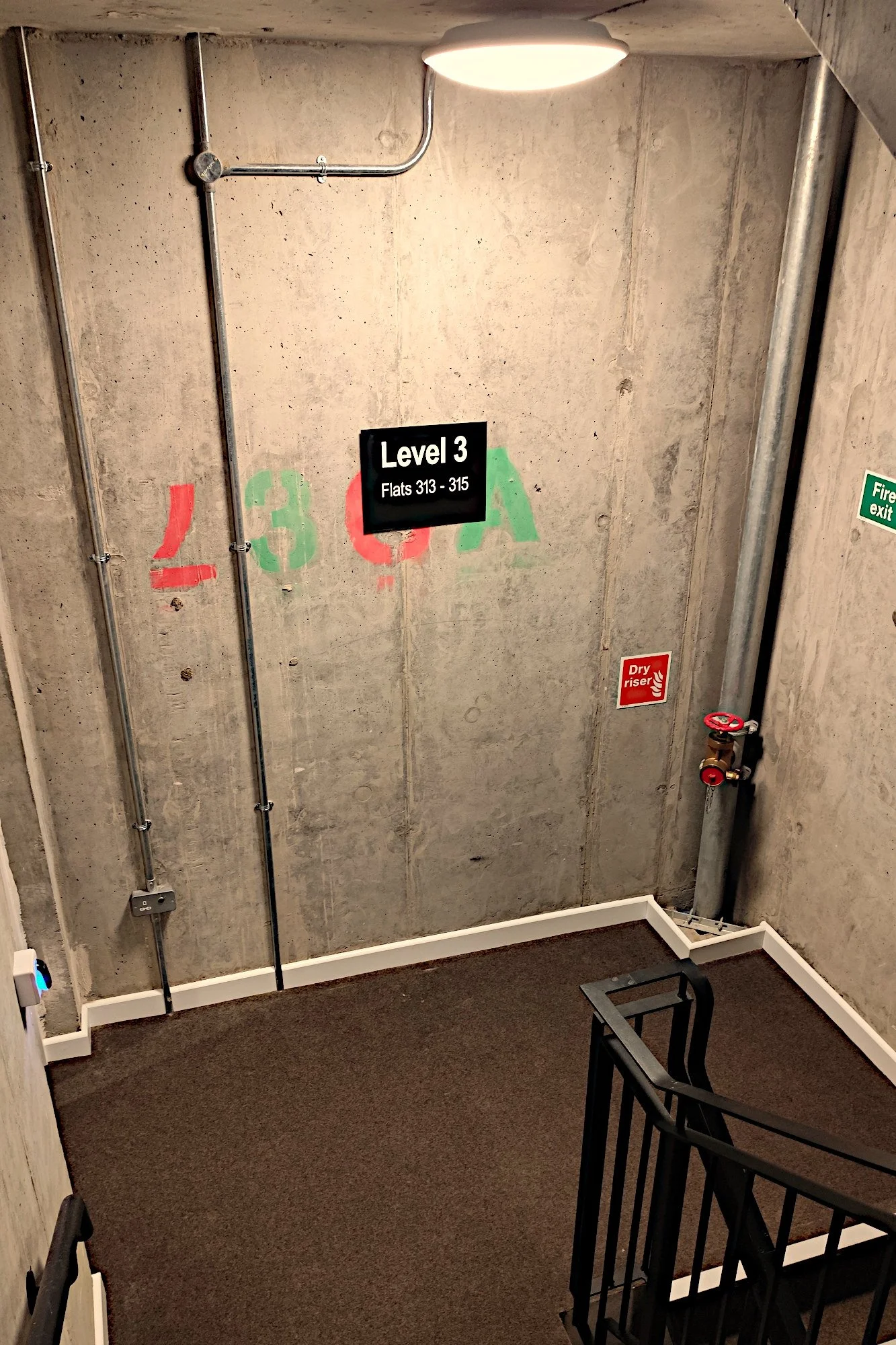
Minimal finishes and hard surfaces are often the result of cost-driven decisions, with acoustic impact rarely considered.
Where this becomes a compliance issue
There is also a compliance point. Requirement E3 of the Building Regulations deals with reverberation in the common internal parts of residential buildings, including stairwells that give access to flats or rooms for residential purposes. In simple terms, the guidance recognises that shared internal spaces should not be left so hard and echoing that sound builds up unnecessarily.
That does not mean every visually untreated stairwell is automatically non-compliant. There may be other ways the design team has sought to address the requirement. But it does mean this is not just a matter of taste. Reverberation in common parts is a recognised part of building performance.
Why this gets value-engineered out
The issue is often missed because the stairwell sits between disciplines. It is not usually the main architectural feature. It may not be central to the sales brochure. It is often seen as a practical fire escape or service route. Acoustic absorption can then be treated as an optional finish rather than part of the performance of the space.
That is where the risk sits for mid-market schemes. The money saved by omitting absorption may be small, but the effect is experienced repeatedly. A resident or guest may not complain formally about stairwell reverberation, and they may not know the regulation. But they will still notice when a shared space feels hard, noisy and low quality.
Where this becomes a commercial problem
For developers and building owners, the risk is not only technical. It is reputational and experiential. A harsh stairwell can contribute to poorer perception of common-area quality, resident or guest dissatisfaction, a more institutional feel than intended, later pressure to retrofit acoustic treatment, and inconsistency between the marketed quality and the actual experience.
This is especially relevant where the building is being positioned above the lowest end of the market. If the sales, rental or guest proposition depends on quality, comfort, design, amenity or hospitality, then the common parts need to support that message rather than contradict it.
A practical design issue, not a luxury finish
The solution does not need to be elaborate. It may involve appropriate absorptive finishes to landings, soffits or selected wall areas, coordinated with fire safety, durability, maintenance and visual requirements. The point is not to make the stairwell luxurious. The point is to stop it sounding hostile.
A stairwell does not need to be a feature space, but it should not feel like an afterthought. In mid-market residential and hotel schemes, untreated stairwells are a false economy. They save a small amount during construction, but can leave a lasting impression of poor quality.
Final thought
The saving from omitting acoustic absorption may be minor, but the acoustic impression is repeated every time the space is used. For buildings that rely on perceived quality, that is a poor trade-off.