
How Much Does a Noise Assessment Cost?
One of the most common questions we receive is: “How much does a noise assessment cost?”
The obvious answer is that it depends on the technical scope of works, including the type of assessment required, the duration of the noise survey, the complexity of the site, the complexity of the proposed development, and whether the assessment needs to consider environmental noise, building services noise, industrial noise, music noise, vibration, or a combination of these.
Those are the visible cost drivers, and they matter. A simple residential conversion will not usually require the same level of survey work, analysis or reporting as a complex mixed-use development, a site affected by commercial noise, or a scheme where detailed mitigation needs to be coordinated across multiple façades, plots or rooms.
But once the technical scope is understood, there is another important cost driver: commercial risk. That risk is governed partly by contract terms, but also by the level of detail, analysis, judgement and long-term consideration built into the assessment.
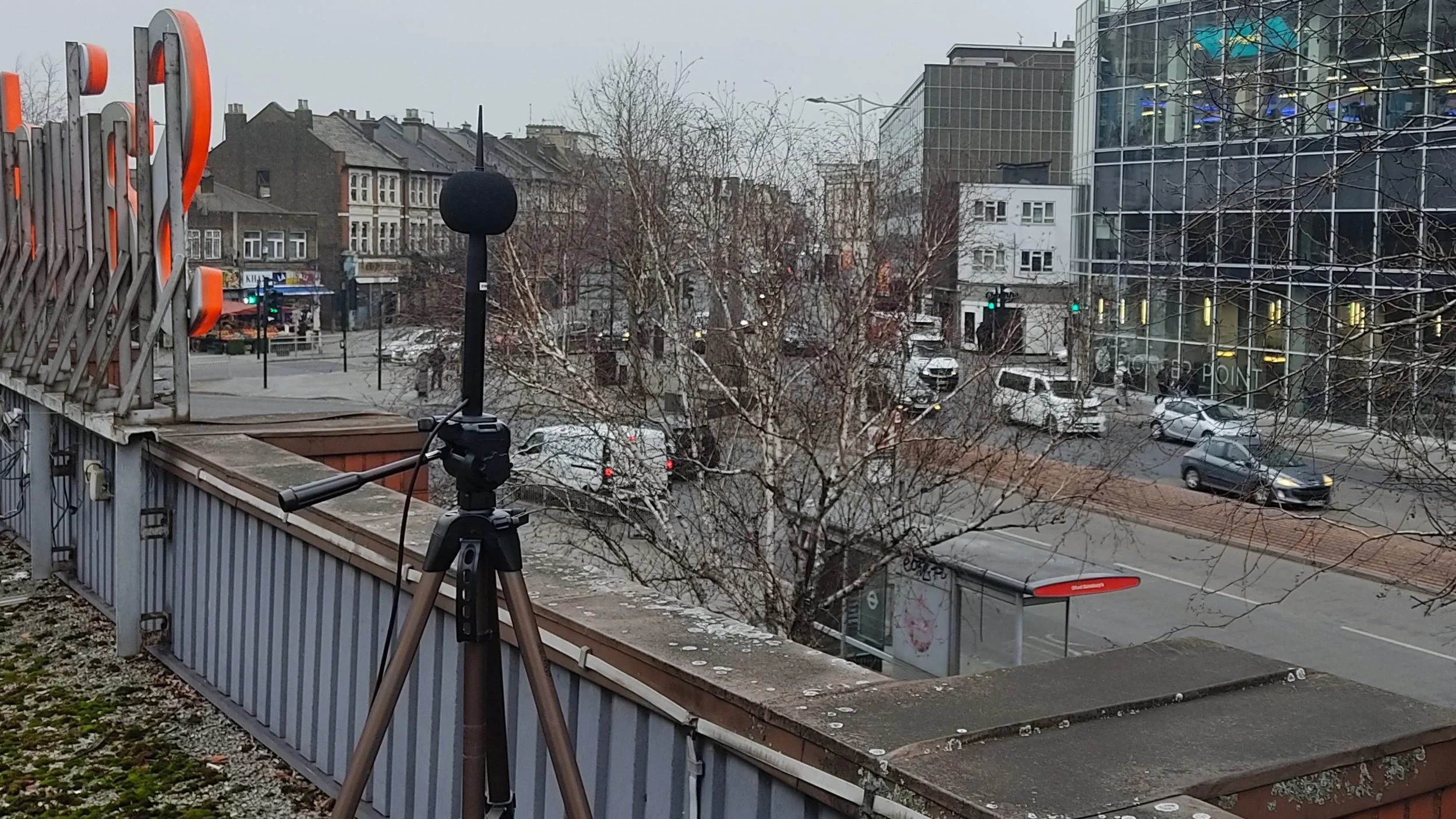
Environmental noise survey being undertaken for a complex mixed-use urban development site, where multiple road traffic, commercial and building-related noise sources required detailed assessment and coordinated mitigation design.
That risk is governed partly by contract terms, but also by the level of detail, analysis, judgement and long-term consideration built into the assessment. A short, tightly scoped report may be entirely appropriate for some projects, but it is not the same service as a detailed assessment that considers planning defensibility, design coordination, plot-specific mitigation and the long-term performance of the development.
Planning decisions can last for decades, so the acoustic assessment is not always just a document for getting through planning this month. It may also become relevant later during detailed design, discharge of conditions, construction, occupation, complaints, enforcement discussions or future disputes.
That is why two quotes for “a noise assessment” can look similar on the surface, while actually pricing very different levels of responsibility, detail and risk
Why Two Quotes For The Same Project Can Be Very Different
It is not unusual for a client to receive two quotes for what appears to be the same project, with one consultant quoting around £1,500 and another quoting closer to £3,000.
At first glance, that can look like a simple price difference. In reality, it may be a difference in scope, detail, assumptions and risk allocation.
A £1,500 quote may be based on a limited planning-stage assessment, a shorter survey period, simplified assumptions, standard mitigation advice and a tightly controlled number of revisions. That may be perfectly suitable where the site is straightforward, the acoustic risks are low, the planning authority’s requirements are clear, and the client simply needs a proportionate report to support an application.
A higher quote for the same project may be pricing a more detailed service. That could include longer survey work, more detailed analysis, plot-specific mitigation, closer review of layouts, clearer technical justification, allowance for design coordination, or additional complexity where the site is affected by multiple adjacent noise sources. It may also reflect the effort required to capture intermittent sources, where survey timing, programming and site attendance need to be planned carefully so that the assessment is based on representative data rather than convenient but unhelpful measurements.
Both quotes may be valid, but they are not necessarily pricing the same outcome. A lower-cost assessment may answer the question, “Can we probably support the planning application?” A more detailed assessment may go further and ask, “What needs to be designed, specified and justified now, so that acoustic mitigation is understood early, shown properly on the planning drawings, and allowed for in the cost plan rather than emerging later as an avoidable design-stage or construction-stage problem?”
That distinction matters because acoustic risk does not always end when planning permission is granted. If the assessment is too thin, too generic or too optimistic, the cost may reappear later through redesign, non-material amendments, fresh planning applications, delayed discharge of conditions, planning objections, additional contractor costs, occupant complaints, or disputes about what the report actually allowed for.
This does not mean every project needs the more expensive option. The useful question is not simply “which quote is cheaper?”, but “which quote matches the level of risk, detail and certainty this project actually needs?”
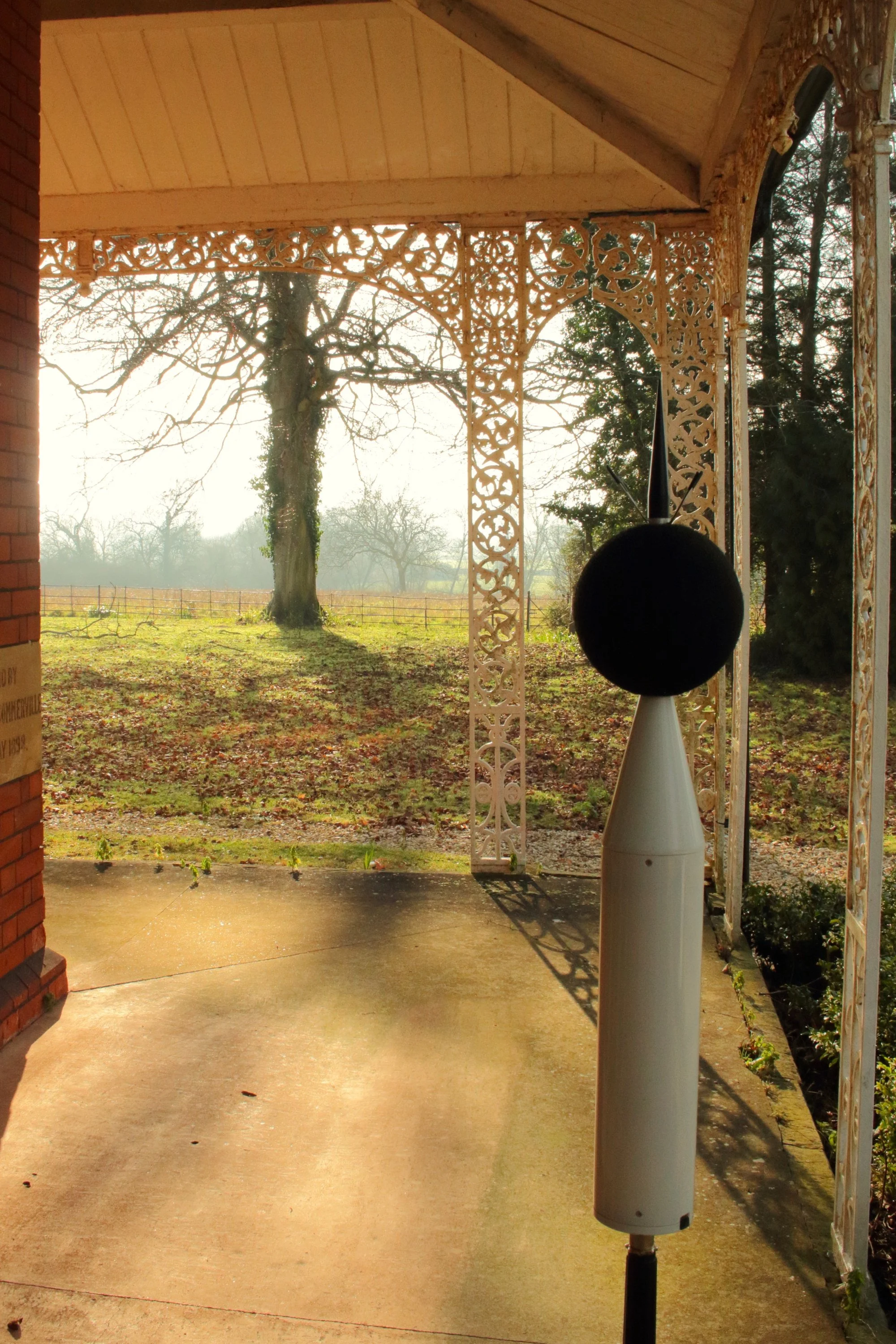
Some sites appear acoustically straightforward at first glance, but future infrastructure, cumulative transport noise and long-term planning considerations can significantly affect the required scope of assessment and level of acoustic risk.
There Is Nothing Wrong With A Lightweight Assessment
Not every project needs the most detailed acoustic assessment available. In some cases, a lightweight assessment, early scoping review or tightly defined planning-stage report may be entirely appropriate.
The key issue is not whether the report is “cheap” or “expensive”. The issue is whether the level of detail is suitable for the decision being made.
Most projects involve a balance between speed, cost and robustness. If the priority is speed and cost, the assessment may need to rely on more limited survey work, broader assumptions and simpler reporting. That can be acceptable where the site is straightforward, the acoustic risk is low, or the client only needs an early indication before deciding whether to proceed further.
However, a lightweight assessment should be understood as exactly that. It may help answer whether a proposal is likely to be acceptable in principle, but it may not resolve every detailed design issue, identify every future mitigation requirement, or remove the need for later acoustic input.
This does not make a lightweight assessment poor quality. It simply means the scope, limitations and risk position need to be clear from the outset
Choosing The Right Level Of Service
Some clients prefer to send over the available information and ask us to recommend an appropriate scope of works. In that situation, we will usually prepare a fee proposal based on our understanding of the site, the planning context, the acoustic risks and the level of robustness likely to be required.
That approach is often appropriate where the client wants the consultant to take the lead in defining what level of assessment is needed.
Other clients prefer a more tightly defined commercial arrangement. They may already know the exact service they want pricing for, particularly where they are comparing consultants directly or working to a strict budget.
For example, a client may ask us to price:
a specific survey duration
a planning-stage assessment only
a limited review of selected drawings
a report without vibration assessment
a faster turnaround with reduced detail
a simpler assessment intended for early feasibility purposes
In that situation, the pricing is based on a defined scope and level of service chosen by the client.
Neither approach is inherently better than the other. Some projects genuinely require detailed analysis and a highly robust assessment. Others may justify a more proportionate or commercially focused approach where speed and cost are more important than exhaustive detail.
The important thing is transparency. The clearer the client’s priorities are in terms of speed, cost, detail and risk, the easier it becomes to align the scope of works and fee accordingly.
Need A Quote?
If you are looking for acoustic consultancy support, the most useful starting point is to send across the project information you already have and explain what you need the assessment to achieve.
That might be a robust planning assessment with detailed mitigation advice, a faster planning-stage report to support an imminent submission, an early feasibility review before committing further design spend, or a tightly defined scope where you already know the exact service you would like priced.
Useful information usually includes site plans, layouts, planning information, draft drawings, existing reports, programme constraints, or simply a clear summary of the project and its current stage.
Some clients want us to recommend the appropriate level of service based on the acoustic risks. Others want a direct quotation for a defined scope of work. Both approaches are valid, provided the objectives, constraints and risk position are clear from the outset.
The clearer the brief, the more accurately the scope, level of detail and fee can be aligned to the project. To discuss a project, contact Kimber Acoustics here: https://kimberacoustics.co.uk/contact