
Control of Noise at Work Regulations 2005: What Employers Need to Know
During one shift, a worker may move between inspection work, powered machinery, vehicle movements and short periods of high level or impulsive noise. The Control of Noise at Work Regulations 2005 require employers to understand the resulting personal exposure and manage the associated health and safety risks.
Compliance depends on representative evidence, accurate exposure calculations and a clear control plan. That includes prioritising engineering controls, recognising that real-world hearing-protector performance is commonly below manufacturers’ standardised test data and checking proper use at or above the upper exposure action values. Kimber Acoustics provides principal-led advice by Robert Kimber MIOA.
An Initial Noise Concern Triggers Defined Employer Duties
Noise can cause permanent noise-induced hearing loss (NIHL) and tinnitus. It can also interfere with communication and warnings and reduce awareness of surroundings, creating additional safety risks.
The Health and Safety Executive’s indicators of a possible noise problem (hse.gov.uk) include intrusive noise for most of the working day, employees raising their voices to talk at about two metres for at least part of the day, noisy powered tools or machinery used for more than half an hour a day, and impacts or explosive sources. These signs should prompt a noise risk assessment to identify who is exposed and what further action is needed. More detailed guidance is provided in HSE publication L108, Controlling noise at work.
Under the regulations, employers must:
Assess the risks where employees are likely to be exposed at or above a lower exposure action value
Eliminate noise risk at source or, where that is not reasonably practicable, reduce it to as low a level as is reasonably practicable
Provide hearing protection on request to employees exposed at or above the lower exposure action values but below the upper exposure action values
Provide suitable hearing protection, and make sure it is used properly, where other controls cannot reduce exposure below the upper exposure action values
Identify and sign compulsory hearing-protection zones where employees are likely to be exposed at or above the upper exposure action values. Restrict access where practicable and justified by the risk, and make sure, so far as reasonably practicable, that employees entering them wear hearing protection
Prevent exposure above the legal limit values
Give employees exposed at or above a lower exposure action value, and their representatives, suitable information, instruction and training
Provide health surveillance where hearing is at risk
Maintain noise controls and make sure they are used correctly
The HSE’s summary of employers’ responsibilities (hse.gov.uk) explains how these duties relate to the action values and exposure limits.
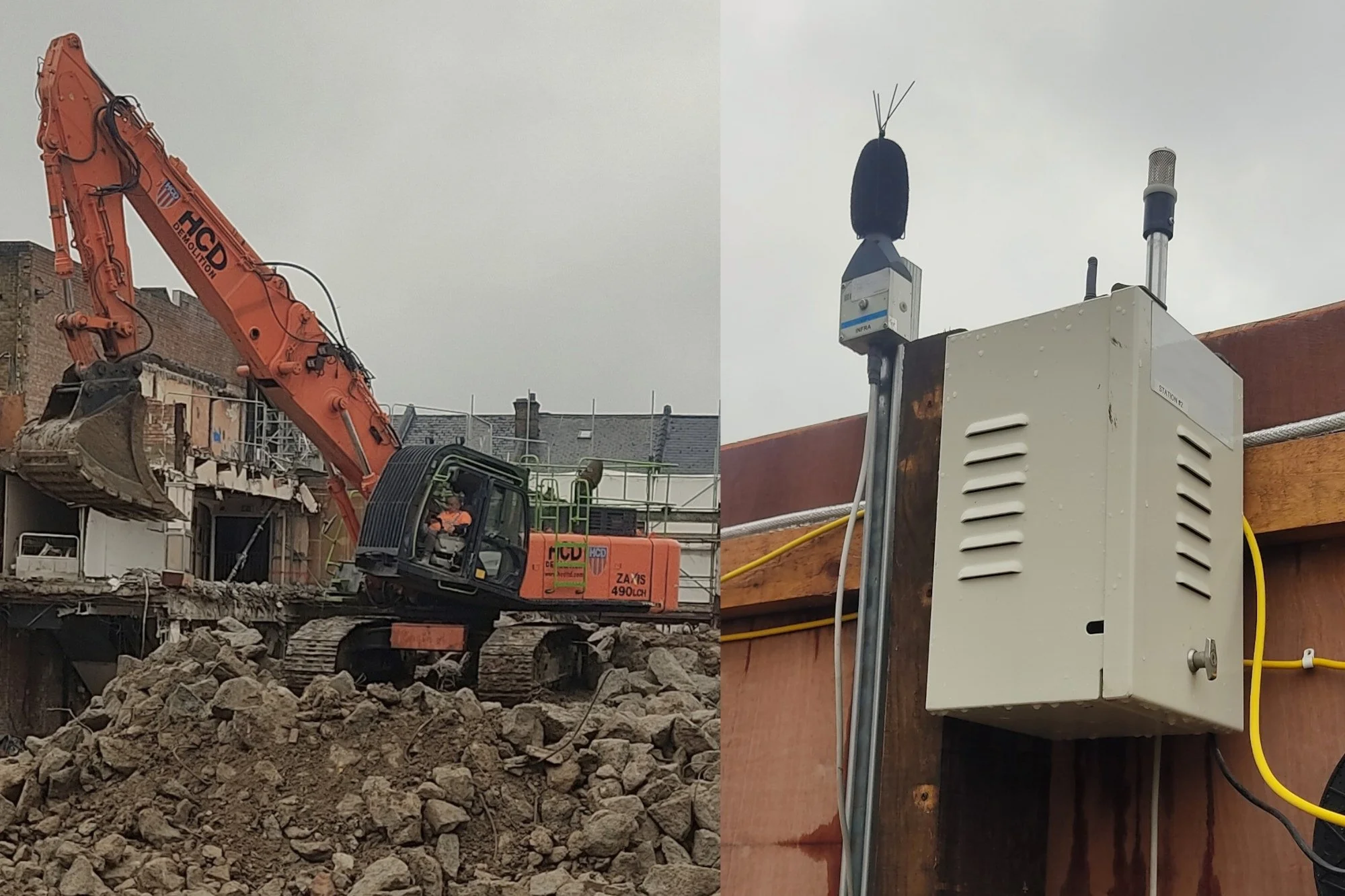
A heavy orange excavator performing demolition work alongside a mounted environmental monitoring unit, the kind of high-impact construction site where intense noise levels trigger strict employer duties to assess and control exposure.
Work Patterns Define the Measurement Plan
Kimber’s occupational-noise service assesses occupational noise exposure from machinery, processes, tools, vehicles and workplace activities. The assessor needs to know who uses or works near each source and for how long.
The scoping review should cover the work employees do, how they do it, day-to-day variation, who may be affected and the information available for estimating exposure.
Available workplace information can help define the work pattern, but the exposure estimate must rely on reliable information such as workplace measurements, comparable workplace information or machinery supplier data.
Spot Readings Can Misrepresent Daily Exposure
A few spot readings may misrepresent daily exposure if they miss noisier tasks or the way the employee’s work varies between days.
The HSE’s noise risk assessment guidance (hse.gov.uk) says employers must be able to show that the estimate is representative of the work and based on reliable information.
This makes survey timing and sampling strategy important. Kimber reviews the available evidence to decide whether additional measurements are needed and which tasks and operating conditions they should cover.
Representative Measurements Create a Reliable Exposure Picture
The measurement programme should follow the real working pattern established during the initial review. Our survey characterises workplace noise conditions across those activities. Our assessment then combines the measurements with representative task durations to estimate personal exposure and compare it with the action and limit values.
A workplace noise risk assessment should be completed by someone competent to assess occupational noise exposure and identify appropriate control measures.
Action Values Turn Exposure Data Into Decisions
Daily personal noise exposure combines the noise level with how long it lasts, expressed over an eight-hour reference period. Where exposure varies markedly from day to day, the regulations allow weekly personal noise exposure to be used instead, provided that the weekly exposure does not exceed 87 dB(A) and appropriate measures are taken to reduce the risk associated with those activities. Peak sound pressure from impacts and explosive sources is assessed separately against its own values.
| Regulatory Level | Daily or Weekly Exposure (LEP,d or LEP,w) |
Peak Sound Pressure (LCpeak) |
|---|---|---|
| Lower exposure action value | 80 dB(A) | 135 dB(C) |
| Upper exposure action value | 85 dB(A) | 137 dB(C) |
| Exposure limit value | 87 dB(A) | 140 dB(C) |
These figures and their associated duties are set out in the HSE guidance on noise levels (hse.gov.uk). At or above the upper exposure action values, the employer must implement a planned programme of technical and organisational control. Exposure is compared with the action values without deducting the attenuation from hearing protectors. That attenuation is taken into account only when checking the exposure limit values, which must not be exceeded.
The need for health surveillance should be considered using exposure before any reduction from hearing protection is taken into account. Health surveillance normally includes regular audiometric testing under the control of an occupational health professional. HSE expects it for employees regularly exposed above an upper exposure action value HSE’s health surveillance guidance (hse.gov.uk) and for anyone else whom the risk assessment identifies as being at risk, such as people who already have hearing loss or are particularly sensitive to damage. Issuing hearing protection does not remove this duty.
The Results Set Priorities for Noise Control
The assessment can identify high-risk activities from representative exposure information. Peak-producing activities require separate attention.
Employers must record the significant findings of the risk assessment and the measures they have taken or intend to take, usually as an action plan that identifies affected employees and the controls needed.
Engineering and Organisational Measures Follow the Risk Ranking
The regulations require a planned programme of technical and organisational control where employees are likely to be exposed at or above the upper action values. The HSE’s guidance on controlling noise risks (hse.gov.uk) directs employers towards quieter processes, equipment and working methods, together with shorter exposure periods.
For manufacturing and other industrial settings, suitable measures may include:
Replacing a noisy process or specifying quieter machinery
Damping vibrating machine panels, which radiate noise as they vibrate
Isolating vibrating machinery with anti-vibration mounts or flexible couplings to limit structure-borne noise
Fitting silencers to compressed-air exhausts and blowing nozzles
Enclosing or screening noisy machinery to block the airborne path to workers
Maintaining noise-control equipment so that it continues to work properly
Considering quieter working methods
Reducing the time spent on exposed tasks
Assigning a responsible owner and timetable for necessary control work
Reliable measurement information and competent advice can inform the employer’s selection of technical and organisational controls.
Residual Risk Requires Managed Hearing Protection
Hearing protection supports the control programme where other controls cannot reduce exposure enough, including where employees remain exposed at or above the upper exposure action values. It may also provide short-term protection while engineering measures are designed or installed. The HSE’s hearing protection guidance (hse.gov.uk) says it should not replace technical and organisational noise control.
Selection requires more than comparing a workplace level with the manufacturer’s Single Number Rating, or SNR. Real-world hearing-protector performance is commonly below manufacturers’ standardised test data because of poor fit and interference from spectacles or other personal protective equipment.
Where noise is dominated by a single frequency, particularly at low frequencies, SNR and HML predictions may be less accurate than the octave-band method.
Apply the 4 dB Real-World Adjustment
HSE guidance on real-world protection (hse.gov.uk) recommends adding 4 dB to the protected level predicted by a standard attenuation method. For example, if an SNR calculation predicts 74 dB(A) beneath earmuffs, add 4 dB and use 78 dB(A) as the real-world protected-level estimate.
Without the 4 dB adjustment, the predicted level may understate the realistic expected level at the ear. The adjustment does not apply when assessing protection against peak noise.
Over-protection also needs attention. Attenuation that reduces noise at the ear below 70 dB can impair communication and warning-signal audibility. HSE advises selecting protection that reduces noise at the ear to below 85 dB while avoiding reduction below 70 dB, with task noise, warning audibility, comfort, hygiene and compatibility with other PPE also considered.
Check Performance on the Shop Floor
Where hearing protection is required, check the protector’s condition, proper use, fit and interference with other PPE, and suitability for the task and warning signals.
The HSE noise checklist (hse.gov.uk) summarises employers’ duties to maintain hearing protection, ensure proper use and provide training.
A Defensible Assessment Must Drive Continuing Action
Technical reporting should distinguish measured fact, professional judgement and client-supplied information.
The report should give the employer and health-and-safety team a practical route forward. That includes prioritised controls, responsible persons, timescales, hearing protection requirements, training needs and any health-surveillance implications.
The assessment remains part of an ongoing management process. Employers should maintain controls, ensure they are used properly and use health-surveillance findings to review them, as set out in the HSE noise-management checklist (hse.gov.uk). HSE’s noise-risk-assessment guidance says the assessment should be reviewed when workplace circumstances change and affect exposure.
A new machine, longer shift or altered production method can change personal noise exposure. A different hearing protector can change the predicted level at the ear and whether the exposure limit value is met, but it does not affect comparison with the exposure action values. Regular checks should confirm that reasonably practicable controls remain in place.
A Useful Quotation Starts With the Shift Detail
To obtain a clear quotation, send us the available process information, shift patterns, machinery details and existing noise assessments. Details of employee roles, task durations, operating variations, peak-noise activities and proposed workplace changes will also help us define an appropriate scope.
Projects receive direct senior input from Robert Kimber MIOA as Principal Consultant. We can then explain what measurements are likely to be needed and quote for a proportionate workplace noise assessment.